Everlasting Place
  • Home
  • One way
    • Proof
  • Sadie Sparrow
    • Sadie Sparrow Excerpt
    • Author Chat
    • Articles
    • Book Reviews
  • Memoir
    • Memoir Excerpts
    • Reviews, interviews & endorsements
  • Blogs
    • Eternal eyes: a blog about forever
    • Golden years: a blog about the elderly
  • Old folks
    • Planting tips for Christians
  • Messages from Chris Carrillo
  • Library
  • Bookstore
  • Contact

Ever feel like Chicken Little?

10/1/2021

0 Comments

 
Picture
Is there anyone in America who hasn’t heard the story of Chicken Little – the chick upon whose head or tail something falls and who immediately erupts into full-blown “THE SKY IS FALLING!” panic?
 
It’s a folk tale that’s either a couple hundred years old or a couple thousand, depending upon who’s telling its history. And there are many different versions out there today, featuring catalysts from an acorn plummeting onto Chicken Little’s noggin to a leaf drifting onto her tail. There are apparently numerous endings available, too, most of them featuring an evil fox eating Chicken Little’s friends for supper.
 
But whatever its denouement, the point of the story is obvious: Don’t ever panic over foolish fears based on sketchy claims from unreliable sources. And for Pete’s sake, if you simply can’t control your terror, keep it to yourself; please don’t infect others with it.
 
Whichever positions you've taken in the current pandemic debates, you have to admit that the world has ignored the lessons of Chicken Little, allowing itself to become overwhelmed by fear.  And if certain observers are correct, it’s only the start; a much more devastating virus may already be on its way, along with another surefire vaccine or two. Grab the kids and head for the hills, Ma!
 
This is not to say that we should just ignore diseases and other dangers. And naturally we should take reasonable precautions: If you’re sick, stay home and resist the temptation to go wandering around a nursing home. If you’re well but have an acquaintance who is sick, don’t pay her a friendly visit until she’s better. And if you’re a healthcare worker, be sure to wash your hands thoroughly between patients, just as Hungarian physician Ignaz Semmelweis advised in 1847.  
 
Of course, many people have good reason to be hysterical over this current pandemic, as well as a host of other potentially deadly dangers. Because the truth is this: We are all going to die, sooner or later. And for many people, death will be the gateway to an eternity in hell, where “there will be wailing and gnashing of teeth,” as Jesus warned multiple times.
 
It doesn’t have to be that way. As any born-again believer in Jesus Christ can tell you, God has made a way for every last person to be saved for all eternity. Here's how: Repent of what He has defined, in His word, as sin; and then trust in Jesus to have paid the penalty for that sin, in full, on the cross. If you do this, you can look forward to heaven as your eternal home, and perfect joy as its endless theme.
 
These are essentially our choices: Embrace the world’s fear and cling to this life as long as possible. Or relax: Embrace the Lord and His plan of salvation. Trust in Him to be in control of every facet of your life. And get ready for an eternity that will be glorious beyond our imaginations.     
 
Don’t believe it? That’s your privilege, of course. But as they say, “Think while it’s still legal.” Investigate the subject for yourself; here’s one place to start. If you do so with all your heart, soul, mind and strength, you’re guaranteed a happily ever after.
 
Hope to see you there!
0 Comments

Is this the best book ever, next to the Bible?

9/2/2021

4 Comments

 
Picture
I didn’t think it would ever happen. But just three short years after falling in love with the Adoniram Judson biography To the Golden Shore, another book is threatening to overtake my heart’s literary #1 spot.
 
That book is Amazing Grace: William Wilberforce and the Heroic Campaign to End Slavery by Eric Metaxas (Harper One, 2007). It’s the story of the horrific African slave trade, and the institution of slavery throughout the British empire, and one man’s epic 20+-year battle to abolish both.
 
Over the years, I had read and heard a great deal about slavery, starting with the enslavement of the children of Israel by the ancient Egyptians, as described in the Bible’s book of Exodus. And of course you can hardly grow up in America without hearing many accounts of the institution’s abominations in the South.
 
But earlier this year, I learned a great deal more from Jonathan Aitken’s stunning biography John Newton: From Disgrace to Amazing Grace (Crossway, 2007). Then, to further my education, Maranatha Baptist University’s Dr. David Saxon and his wife Jamie recommended that I read this Wilberforce biography.  
 
After sketching out the content of the book for me, Jamie Saxon added an irresistible incentive: “You’ll love his writing.” And indeed, my review of this book really has to start with a mention of the extraordinary writing of Eric Metaxas.
 
I always mark up my books, but normally only to highlight important facts. Not this time: At least half of my mark-ups are to call attention to particularly elegant language, or especially poignant observations, or even the author’s wonderful sense of humor (amazingly, there’s plenty to laugh about even in this dead-serious book about the abolition of slavery – more proof of Metaxas’s unique gift, I suppose). You’ll find just a few examples of his skill in the excerpts below.
 
So, in a nutshell, William Wilberforce (1759-1833) was a brilliant and wealthy British politician and Member of Parliament who spent the first years of his career as a party animal; became a born-again Christian in his mid-20s; and eventually, having heard about the ghastly ways that African slaves were treated during and after their transport to the New World, embraced the cause of abolition.
 
Metaxas’s account of Wilberforce’s conversion to Christ is alone worth the price of the book. What Wilberforce would later call his “Great Change” didn’t happen overnight. But it seems that a key event in this process was a horse-drawn chaise trip he and his equally brilliant friend Isaac Milner took from Nice to Calais, over 1200 miles of winding, unpaved roads in heavy snowfall. To occupy themselves, they read and discussed Philip Doddridge’s 1745 book The Rise and Progress of Religion in the Soul. Writes Metaxas of this journey:
 
“The extraordinary felicity of this scene, of these incandescent minds meeting on this subject of eternal things, sailing in their horse-drawn coach through the mountains, seems like something out of a fairytale, one in which a gnome and a giant on a journey in a sphere of glass and silver discover the Well at the World’s End, and drinking a draught therefrom learn the secret meaning at the heart of the universe.” (pp. 47-48)
 
It was this journey that apparently changed Wilberforce’s heart once and for all:
 
“Anyone who had been privy to his thoughts at this time would have wondered what had happened to the gay, carefree fellow of just a few months before -- the one … who had thought nothing of shaving the truth here and there during his speech in the castle yard at York to ‘tear the enemy to pieces’ and elevate himself to the highest parliamentary place in the land; who ate and drank and danced and sang till the wee hours of hundreds of mornings. Where had that fellow gone?” (p 49)
 
It’s uncertain exactly how this new creature in Christ first came to make the abolition movement his life’s work. Ex-slave-trader, beloved pastor and “Amazing Grace” author John Newton was a family friend, and no doubt his conversation had something to do with it. And along the way, Wilberforce also befriended a number of other folks who would play key roles in his campaign.
 
It’s possible that Wilberforce’s attention was first arrested by the accounts he heard and read of “the Middle Passage” – the second leg of slave ships’ trip from England to Africa, Africa to the New World, and then home to England again. It was in Africa that the English traders kidnapped men, women and children, often with the help of local chieftains, and packed them into ships without regard to their health or comfort.
 
The conditions were unimaginably awful: overcrowding so excessive that in some cases the captives were piled on top of each other; no fresh air; suffocating heat; and relentless stench. Many died outright during the ensuing weeks, before being unloaded on the other side of the Atlantic. And in at least one case known as the Zong Incident, 131 sick and even relatively healthy slaves were simply tossed overboard into the ocean to drown or be devoured by sharks. The reason: the captain would be rewarded for his work by the value of his cargo at auction, and sick slaves didn’t fetch much; but dead slaves were covered in full by insurance.
 
Metaxas quotes extensively from some of the first-person accounts of the atrocities. I won’t repeat any of them here. I can’t. You must read them yourself. Try not to weep.
 
But it must have been such accounts that transformed Wilberforce and his companions into passionate enemies of slavery. And thanks in part to their zealous efforts to capture the hearts of British citizens, the abolition movement gained strength throughout England in the last quarter of the 18th century.
 
It’s important to recognize the spiritual nature of this movement. As the author notes, “The acutely Christian character of the British abolitionist movement is undeniable, for its leaders were all consciously acting out of the principles of their deeply held faith.” (p 96)
 
Yet some of abolition’s enemies claimed to be Christians, too. Metaxas comments: “For this the leaders of the Church of England, not merely the people in its pews, were to blame. The Church of England at the time had a great deal of money invested in West Indian plantations and did not make any connection between the tenets of the Christian faith and abolition. Making that connection fell to outsiders – to the Methodists and other so-called Dissenters, such as the Quakers and Moravians.” (p 96)
 
(An aside: the author’s discussions of England’s “retreat from serious Christian faith” in the 18th century is one of the fascinating subplots in this book.)
 
At any rate, Wilberforce became convinced that he must lead the charge against the slave trade in Parliament. For “if, as [he] thought, God Himself was calling him to this task and he shrank from it, God too could find another to do it, and surely would.” (p 113)
 
It was a highly complicated, heart-wrenching and endlessly frustrating era for Wilberforce, and it involved domestic and international political machinations that would surprise even the careful observer of 21st century American politics. It consumed him for over two decades, robbing him of his peace and his health as he approached Parliamentary victory again and again, only to suffer defeat after debilitating defeat.
 
Wilberforce received a great deal of encouragement along the way, however. For example, in perhaps the last letter he ever penned, just a few days before his death, John Wesley wrote to Wilberforce. He said, in part, “…if God be for you, who can be against you? Are all of them together stronger than God? O be not weary of well doing! Go on, in the name of God and in the power of his might, till even American slavery (the vilest that ever saw the sun) shall vanish away before it.”
 
Metaxas’s comment on this letter: “What an encouragement it must have been to read these words from the battle-scarred veteran, who had fought the good fight, and run with patience the race, and had kept the faith … And so William Wilberforce now ran, cheered on by a great and growing cloud of witnesses.” (p 145)
 
Wesley’s last epistle arrived in February, 1791. It would be almost exactly 16 years later, in 1807, that the battle would finally be won, with abolition secured in Parliament by a resounding vote of 283-16.
 
Throughout the painfully long proceedings, Metaxas reports, Wilberforce “had sat composed, quite composed.” But when the final vote was tallied, and the rejoicing began, “he was overcome, and taking his head in his hands, he wept.” (p 210)
 
As we watch the celebration unfold, the reader rejoices with the author, and very belatedly, with all those who made this victory possible. It was over! Surely the work was only beginning, but the strongest enemy had been defeated! Hallelujah!
 
But wait: “Let’s not run ahead just yet,” Metaxas says. “Let’s behold [Wilberforce] here for a little while longer, here in this Moment of moments, a man allowed that highest and rarest privilege, to be awake inside his own dream. Seated there, head in his hands, humbled and exalted in his humility, we have the apotheosis of William Wilberforce.” (p 211)
 
And there’s more. Oh, so much more! But my review is already way too long. You simply must read this book. Don’t delay. Read To the Golden Shore, too, and then you can decide for yourself which one is more life-changing.  

In the meantime, I have to run and order another book by Eric Metaxas. Bonhoeffer, perhaps, or maybe Martin Luther ... 
4 Comments

Biblical paradoxes

8/20/2021

1 Comment

 
Picture
The Bible is packed with passages both pithy and profound on just about every subject imaginable. Jesus Himself had astonishing things to say about everything that’s important in this life.
         
He spoke about the material, for instance: “Do not lay up for yourselves treasures on earth, where moth and rust destroy and where thieves break in and steal; but lay up for yourselves treasures in heaven, where neither moth nor rust destroys and where thieves do not break in and steal. For where your treasure is, there your heart will be also.” (Matthew 6:19-21)  
         
He spoke of God the Father’s overarching love for the humans that He created in His image. “Are not two sparrows sold for a copper coin? And not one of them falls to the ground apart from your Father's will. But the very hairs of your head are all numbered. Do not fear therefore; you are of more value than many sparrows.” (Matthew 10:29-31)
         
And He defined love in a way that raises eyebrows in an anti-authoritarian culture like ours. “If you love Me, keep My commandments.” (John 14-15)
         
It would be quite a challenge to narrow a list of Jesus’ most astounding sayings down to even a few dozen. But I think perhaps my favorites are His paradoxes – those statements that sound self-contradictory at first, but serve to underscore how His worldview is the polar opposite of mankind’s.
         
Just a couple of examples: “He who finds his life will lose it, and he who loses his life for My sake will find it.” (Matthew 10:39)
         
And “I am the resurrection and the life. He who believes in Me, though he may die, he shall live. And whoever lives and believes in Me shall never die." (John 11:25-26)
         
In some ways, the believer’s life is full of paradoxes. As the late pastor and author A. W. Tozer said, “A real Christian is an odd number. He feels supreme love for One whom he has never seen; talks familiarly every day to Someone he cannot see; expects to go to heaven on the virtue of Another; empties himself in order to be filled; admits he is wrong so he can be declared right; goes down in order to get up; is strongest when he is weakest; richest when he is poorest and happiest when he feels the worst. He dies so he can live; forsakes in order to have; gives away so he can keep; sees the invisible; hears the inaudible; and knows that which passes knowledge.”
 
Does this describe the Christ-follower you aspire to be? If not, it might be worth your while to spend a little time meditating on another seemingly paradoxical quote from Jesus (Matthew 7:21-23):
 
"Not everyone who says to Me, 'Lord, Lord,' shall enter the kingdom of heaven, but he who does the will of My Father in heaven. Many will say to Me in that day, 'Lord, Lord, have we not prophesied in Your name, cast out demons in Your name, and done many wonders in Your name?' And then I will declare to them, 'I never knew you; depart from Me, you who practice lawlessness!'”
 
To prevent us from dismissing this warning as irrelevant to our own fine Christian lives, Jesus went on to highlight the importance of explicitly obeying Him (verses 24-27):
 
“Therefore whoever hears these sayings of Mine and does them,” He said, “I will liken him to a wise man who built his house on the rock: and the rain descended, the floods came, and the winds blew and beat on that house; and it did not fall, for it was founded on the rock. But everyone who hears these sayings of Mine, and does not do them, will be like a foolish man who built his house on the sand: and the rain descended, the floods came, and the winds blew and beat on that house; and it fell. And great was its fall."
 
Of course, obeying Christ presupposes that we know His commands. And this can be achieved only by studying His word to gain not just knowledge, but also wisdom and understanding – that is, learning how and why to apply our Spirit-imparted knowledge to our daily lives. There’s nothing paradoxical about that! 
1 Comment

Losing your mom

8/6/2021

2 Comments

 
Picture
Sooner or later, most of us will go through the horrible process of losing, and mourning, our mothers. But I've just been reminded that there is a way through and past this uniquely devastating form of grief. 

The reminder came via my friend Kathy, who lost her beloved mom several years ago. She sent me an article from an old CareNotes, a publication of One Caring Place.  In this piece, author Peggy Heinzmann Ekerdt provides some wonderful insights into what can make this event so personally catastrophic. 

For instance, as Ekerdt points out, losing your mom can mean losing: 

  • Your sole source of unconditional love. A mother’s love “is often tested, but rarely fails. So when a mother dies, the loss of unconditional love is often a loss that no one else can understand, much less fill.”
  • Your identity. “It is as though a fundamental part of me has existence only in my mother’s memory,” writes Ekerdt, quoting Roberta Bondi in Memories of God, “and when my mother dies this part of me will die, too.”
  • Your family connector. “When a mother dies, some … wonder why they feel as if they have lost touch with siblings.” As my own sister said in the wake of our mother’s death, “Mom was the glue that held us together.”
  • Protection. “There is a sense of security that accompanies the knowledge that even into adulthood, mothers look out for their children, and God help anyone who attempts harm. That shield of protection, both physical and emotional, is lost when a mother dies.”

In this article, Ekerdt has taken a secular approach to the subject – no doubt because it’s the only way to avoid offending some people in this perennially offended culture we live in today.

But as I read it, I was reminded that there is a source of unconditional love, identity, family connection, and protection that transcends what even the most wonderful mother could ever provide: and that’s our Creator, the God who reveals Himself to us in the Bible.

After all, God is love, as the apostle John tells us in 1 John 4. He loves us so much that He died to pay the penalty for our sins. And He forgives those who repent and trust in Him, so completely that He separates us from our transgressions as far as east is from west (see Psalm 103). 

What’s more, that fundamental part of me that existed in my mom’s memory also exists in the Lord’s – and it does so perfectly, without the affectionate “re-interpretation” a mother may give it. That may not seem like such a good thing, having our Creator know everything about us, warts and all. But see above; He forgives!

And how about that family connector? When we become His children through repentance and trust, we also become members of the most astonishing family of all – His church. Even if this life were all there is to our existence, it would be a tragedy to miss membership in this family; I doubt that there’s any greater love among human beings than what can be experienced in a fellowship of born-again believers in Jesus Christ. 

And protection? There’s none like the Lord Himself. He is in sovereign control of all our circumstances, and He makes all things work together for the good of those who love Him and are called according to His purpose (see Romans 8). That’s true even if a particular circumstance feels for the moment like the opposite of protection; sooner or later, if we are paying attention, we will see that He allowed it for our good.   

Best of all, He has promised never to leave or forsake us (Hebrews 13:5). He will always be His children’s unfailing source of unconditional love, identity, connection, and protection. 

It’s been 21 years since I lost my mom. I still miss her terribly, and can’t wait to see her again in heaven. But what a comfort it is to know that the Lord God Himself provides all that a mother can provide and infinitely more – and not only in this life, but for all eternity.
2 Comments

Reaching a prodigal child

7/30/2021

0 Comments

 
Picture
One of the questions I’ve heard most often over my years as a nursing-home volunteer is this: How can I help my beloved unbelieving child to at least consider Christ?
 
I’ve given this question a great deal of thought: What might someone have said to capture my attention for Christ, and my heart, years earlier -- especially so that my mom and I could have had some time together in the Lord before she died?
 
Alas, I don’t have a clue.  I can’t imagine anything that anyone could have said that would not have simply infuriated me.
 
Still, my mother got through to me in the end, because through it all, she quietly and subtly continued to witness for Jesus Christ:

  • She never made a secret of her commitment to Him, or of the fact that her unwavering confidence in her heavenly destiny rested solely in Him.
  • Nor did she ever hide her biblical moral standards.
  • She didn’t even comment when I extolled the virtues of being a feminist workaholic and, by implication, blasted the stay-at-home motherhood that had been her life.
 
Instead, she simply loved me with what came awfully close to the sacrificial, selfless agape love of God (see 1 Corinthians 13).   
 
As a result, when she died, I lost my only earthly source of unconditional and sacrificial love. Which is why it became imperative for me to search so diligently for the truth about eternity. And as God said through the prophet Jeremiah,  “you will seek Me and find Me, when you search for Me with all your heart” (Jeremiah 29:13).
 
But is simply loving your beloved prodigal always the solution?
 
I think so -- love, together with ceaseless prayer.  I know quite a few believers who came to Christ late in life, and in nearly every case it was the combination of prayer, love and heartbreak that brought them into the kingdom of God.  
 
So if there’s a prodigal in your life, that’s my recommendation: pray without ceasing, make no secret of your beliefs, and love your prodigal into the kingdom of God.
 
Don’t worry if you don’t see fast results. As the apostle Paul said in 1 Corinthians 3, there’s one who plants, and another who waters, but it’s God who gives the increase – and this can all take a while! Just relax and remember that His timing is perfect.
 
In fact, don’t be concerned if you don’t see results in your lifetime. My mother did not, after all … but if she doesn’t yet know what impact she had on me, she will one happy day.  
0 Comments

Tapestry

7/13/2021

0 Comments

 
Picture
A darling great-niece sent me this amazing poem by Corrie Ten Boom – the Dutch Christian who famously hid Jews from the Nazis, suffered for her “crimes” in the Ravensbruck concentration camp new Berlin, and lived to tell her story in The Hiding Place.
 
The Tapestry

​My life is but a weaving
between my Lord and me;
I cannot choose the colors,
He worketh steadily.
Oft times he weaveth sorrow,
and I, in foolish pride,
forget he sees the upper
and I the underside.
 
Not ‘til the loom is silent
and the shuttles cease to fly,
shall God unroll the canvas
and explain the reason why.
The dark threads are as needful
in the Weaver’s skillful hands,
as the threads of gold and silver
in the pattern He has planned.
 
I’ve often tried to express this thought, even using the tapestry analogy, but never as clearly as Corrie did with these 84 simple words.
 
Nor have I ever come close to explaining this idea as concisely as the apostle Paul did in Romans 8:28: “And we know that all things work together for good to those who love God, to those who are the called according to His purpose.”
 
In 1 Timothy 2:3b-4, Paul added that “God our Savior … desires all men to be saved and to come to the knowledge of the truth.” And maybe that’s the larger point: The undersides of our tapestries may look dull or even hideous to us in this life, particularly as we approach its end – but the Lord is creating the precisely the image needed to bring each of us into His heavenly kingdom, safe and joy-filled forevermore.  
0 Comments

Why won't you listen?

6/25/2021

4 Comments

 
Picture
I woke up this morning thinking about what sort of post I would write if this were my parting shot – if my life on this earth were to end today, through death or rapture.
 
And immediately this question popped into my head: why won’t you listen? Directed, of course, to those of the “don’t talk to me about Jesus” persuasion. Those who assume that, if there’s an afterlife, they’re good enough to be welcomed in the best places. Those who feel someone walking over their graves whenever a genuine Christian enters the conversation. Or the room.
 
A good question for me, since I spent 30 years of my adult life in that camp. Why did I automatically turn off and turn away from any follower of Jesus Christ?
 
Here are a baker's dozen of reasons for rejecting the Savior and His ambassadors, along with brief counterarguments from biblical Christianity. They’re presented in no particular order; they re-arranged themselves day by day depending on what evidence I was ignoring.
 
Are they perhaps among your arguments against Jesus?

1. Christians are boring. And I just want to have fun.  

This was one of my biggest surprises once I’d embraced Christianity. I had merely been seeking the truth about the afterlife, figuring I would probably be giving up my good times if the Bible turned out to be true.
 
Boy, was I wrong. I didn’t know what “fun” was until I became a child of God. In fact, since repenting and trusting in Christ in 2000, I have laughed longer and harder and more regularly than ever; Christians can be a scream!
 
But that’s just the beginning. For instance, I am daily lost in the beauty of God’s creation and His word, the Bible. I have been absolutely blown away by what I’ve learned in lectures exploring real science and what it reveals about the Creator. And I have been deeply comforted through life’s greatest sorrows, traumas and fears, with God Himself restoring me to His joy in practically no time at all.
 
In short, thanks to Jesus, I’ve lost nothing, and gained everything.

2. Science has disproved the Bible.  

This objection turned out to be laughable; just the opposite is true. In reality, the Bible reveals in passing many facts about our universe that have only been “discovered” by secular science in recent years. Just two examples: the sun having its own orbit and the ocean floors having mountains and valleys. And don’t get me started on the fact that the Bible said the earth is round about 200 years before Greek mathematician Pythagoras stumbled across the idea.
 
For details, read Heaven Without Her, or virtually any of the books recommended here. Or visit Answers in Genesis or the Institute for Creation Research. If you approach any of these resources with an open mind, you will be astounded, and you may be forever changed.

3. You can’t possibly know the future.  

You’re right, I can’t. But as the Creator of the world and of time itself, God knows perfectly well what will happen.  And He has told us everything we need to know about it via His word.
 
In fact, one-third of the Bible is predictive prophecy. Most of it has already been fulfilled with 100% accuracy. And the rest concerns our world’s last days; we’re now seeing it all unfold with stunning speed and precision.

4. Biblical prophecy is nothing more than a lucky guess.  

Consider this: There are more than 450 Old Testament prophecies of the coming Messiah. As the Dead Sea scrolls confirmed, all were written long before Jesus’ birth. Yet Jesus fulfilled every last one of these prophecies to the letter.
 
The late Peter Stoner, Professor Emeritus of Science at Westmont College, calculated the chances of one person fulfilling just 48 of these prophecies at 10 to the 157th power. This is a number beyond our comprehension; some scientists have calculated the number of electrons, protons and neutrons in the entire universe at 10 to the 79th power. 
 
No lucky guesses here, folks.

5. Biblical prophecy is matched by people like Nostradamus and Jeane Dixon.
 
Not by any stretch of the imagination. You can look it up.
 
The fuzzy wuzzy predictions of 16th century mystic Nostradamus took the form of vague and unsettling quatrains that today’s readers tear apart and reassemble in vain attempts to make them look authentically prophetic.
 
And Jeane Dixon? Turns out she got an awful lot wrong, including warning that World War III would begin in 1958. She and her fellow mid-20th-century psychics didn’t even get half of their predictions right, according to those who track such things; coin flips and Magic 8-Balls may well be more accurate.

6. I’m a good person; I’ll be welcomed in any heaven.  

Are you really? How well have you kept the Ten Commandments? Have you ever lied? Stolen? Lusted or been unjustly angry with another human being (Jesus’ definitions of committing adultery and murder in the heart)? Have you ever coveted something belonging to someone else?
 
Or, if you reject the Ten Commandments, then consider this: How much time have you spent in the last month justifying your behavior towards another human being? Saying, for instance, that he deserved your wrath because of the awful things he did, or that she needed to hear the rumors even if they were painful to her? Hint: If your God-given conscience is clear, you don’t ever need to justify yourself. If it’s not, then you are not a good person; you are just like the rest of us.  

7. There is no life after death.  

How do you know that? “I feel it in my gut” is not proof. Neither is “someone I admire told me” or “I read it in a book” or “Richard Dawkins says so and he’s really smart.”
 
You’re taking a big risk if you’re counting on sources like these.

8. Christianity is way too judgmental.  

What you mean is that Christianity teaches against the guilty pleasures that you and your friends enjoy, right? Or, as I put it in my atheist days, “the God of the Bible just wants to ruin our good times.”
 
Huge subject, well worth exploring in great depth. For the moment, let me just say this: It turns out that every biblical command was issued for your own good, and obeying them is the only way to achieve peace, contentment and joy in this life.
 
I know, it surprised me, too.

9. The Bible was written by men – ancient, ignorant men.  

This is true, at least the “men” and “ancient” part of it. There were around 40 of them writing over about 1500 years, and they were each inspired by the Holy Spirit.
 
How can we be sure of that? Because they each revealed things that they could not possibly have known – the aforementioned scientific and prophetic facts, for example. They could only have known these things if they were inspired by someone outside of time. By God Himself.

10. I prefer _____________ (the New Age, Hinduism, Buddhism, Islam, whatever).
 
So what? Are you interested in truth or fashion? (And, I should add, just try to find proof of any system of belief other than Christianity. It doesn't exist.)

11. Christianity oppresses women.  

Another laughable charge.  The Bible is set among ancient cultures that were practically misogynistic by today’s standards. Examine how women are treated in its pages. And observe Jesus’ behavior towards women. There's nothing oppressive about it. 
 
Yes, God established sex-based roles and rules for the family and the church. And He instructed women to be submissive to their husbands. But at the same time, He commanded men to honor their wives. Seems like a good deal to me. 
 
Besides, it’s His creation. He had a right to set things up however He wanted to.

12. With all the suffering and evil in the world, this God of yours is either powerless or evil Himself. More likely, He doesn't exist at all. 

The Bible gives us many reasons that the Lord allows great tribulation in our lives. He can use it to guide or discipline us. He can use it to accomplish His purposes or display His power. He can use it to impact our loved ones. And He can use it to get our attention, especially if we are unbelievers.  
 
If you are suffering today – physically, emotionally, financially, or spiritually – perhaps God is trying to get your attention. Rest assured that He knows about it, controls it, and is at work in your life. Please understand that this may be the only way He’ll ever be able to get your attention, and therefore to save you for all eternity – putting you irrevocably on the path to heaven, as promised in the gospel of Jesus Christ.

Will it work? That’s up to you. I pray it will!

13. My loving god would not send anyone to hell.  

You’re right, he or she would not. That’s because he or she does not exist. Am I wrong? Where’s your proof?
 
The God of the Bible is love. He doesn’t send people to hell. Instead, He made a way for every human being to spend eternity with Him in heaven – a way that requires us to simply repent of what He says is sin, and trust in Jesus Christ to have paid our entire sin debt on the cross. Do that sincerely, and you’ll be clothed in the perfect righteousness of Christ for all eternity.
 
Is that too much to ask of you? Then you’ll have to stand in front of Him in judgment one day, and explain why you’re perfect enough to be allowed into His perfect heaven. You won’t be able to. And then there will be only one possible destination for you for all eternity.
 
That’s not even the
tip of the iceberg
 
Entire books can be and have been written on each of these subjects. Why, I could probably write entire books on them myself, off the top of my head, so obvious is truth once you start seeking it.
 
Do these points cover your key arguments against Christianity? Or do you have some that are uniquely your own? If so, I guarantee that committed Christians everywhere would love to hear them. Please feel free to insert them in the comments section below.
 
In the meantime, just consider this: There is not an argument against Christianity that cannot be easily addressed and overcome. I undoubtedly suspected this as an atheist, which is probably why I worked so hard to avoid anything even remotely related to Jesus.  
 
I have many regrets in this life, but the biggest is that I didn’t seek truth when I was young.
 
The good news is that, as long as you’re still breathing, it’s not too late. But don’t miss that final deadline. As Jesus said, “Ask, and it will be given to you; seek, and you will find; knock, and it will be opened to you” (Matthew 7:7). Don't wait another day. 
4 Comments

The most thrilling way to live

6/16/2021

0 Comments

 
Picture
"The summer before my ninth birthday – the summer of Nikita Khrushchev and the Berlin Wall and all the circumstances that would turn [doomsday neighbor] Mrs. G. into a terrifying false prophet – my parents traveled to Europe for the summer with my sister Andy, then 17. Since I was too young to appreciate such a trip, they took me to Madison, about 150 miles southwest of Green Bay, to spend the weeks with their dear friends Arlene and George.
​
"In most ways, it was a heavenly place to await their return. Arlene and George were among my favorite people in the whole world, kind and loving and happy just like my own parents, and they never failed to lavish some of their love on any children in their vicinity. They lived in a tree-lined neighborhood very much like our own, full of charming older homes and kids and family dogs, in a neat white two-story house.

"They had one daughter who was still at home – a girl who was probably an exotic 13 or 14 at the time, and who was much nicer to me than I would have been to a summer-long intruder. And Arlene, no doubt anticipating how homesick I would be, gave me a gift every Friday to help me celebrate making it one week closer to Mom and Dad’s return. I’ve forgotten what almost all of those gifts were, except for an Etch-a-Sketch – a drawing toy so new that I’d never even seen one before, so enchanting that I spent the rainy days of summer learning how to draw with it.

"Arlene even found a playmate for me. Her name was Maureen. She was my age and lived up the hill from Arlene’s house. Her house was exotic, too: it had no upstairs, and her backyard was all wooded, and there were these beautiful flowers in front, in a bed framed by split-rail fencing; I remember in particular stunning orange blossoms with freckles, which my new friend called tiger lilies.

"Maureen and I spent lots of long summer days together, exploring the neighborhood and the woods beyond, playing games like Sorry and Old Maid, piecing together jigsaw puzzles, packing lunches and taking off on our bikes – the daughter let me use hers! – to destinations unknown. You could do that in those days; adults didn’t worry if the children in their charge disappeared for six or eight hours, as long as they were home in time for supper.

"Thanks to this wonderful, warm cast of characters, it was one of the best summers of my childhood. Except that I wasn’t at home with my parents, and I ached for them. And so it was also the only unhappy summer of my childhood. Good and bad, rolled into one.
​
"In the end, though, the good outweighed the bad, because I knew the bad would come to an end. I had no doubt that my parents would come get me eventually and take me home, and in fact when I thought about that, when I pictured them pulling up in front of Arlene’s house, I could barely contain my joy.

"It’s kind of the way I feel now that I’m a heaven-bound Christian whose parents and Granny have gone on ahead.

"Others, even some other Christians, seem to think I’m crazy and quite possibly suicidal. But I am neither. They simply don’t understand, maybe because they never had a summer-of-1961 experience like mine.

"Which is too bad, because it’s a totally thrilling way to live.

"On the one hand, I am surrounded by people I love – a fine husband and extended family, an array of good friends, a church family whose loving-kindness is astounding. I live in a nice house with a big garden and all the pets anyone could ever want. I enjoy my work most of the time – especially since my commute is about 10 steps from the kitchen and it can be traversed in warm slippers or bare feet, depending on the season. And I spend much of my free time studying mind-blowing books about all things related to the Lord, most importantly the Bible.

"What more could I want?

"I honestly can’t think of a thing – not even my friends’ lake-side cottages or fat retirement accounts or exotic vacations could add anything to my joy. Not even another Super Bowl season for the Packers.

"Life is good.

"And yet.

"My mom and dad and Granny aren’t here. They’ve already departed for our new Home, leaving me behind, unable to get to them under my own power.  And so I am at times consumed with a new kind of homesickness – a longing to be with them in the Lord’s kingdom, a land where there are no tears, no aches and pains, no disease or death, hunger or thirst, just Jesus and joy that we can’t even imagine in our earth-bound 3D hides.

"And so I ache once again. And once again it’s mostly a good ache, one that’s accompanied by butterflies and by capital-H biblical Hope – not merely a wish but a confident expectation about what is to come.

"Life is indeed good. But it’s going to get a whole lot better one day. And it’s all going to happen in the twinkling of an eye."

​From Heaven Without Her, pages 249-25

0 Comments

Where's your treasure?

5/28/2021

0 Comments

 
Picture
“And He said to them, ‘Take heed and beware of covetousness, for one’s life does not consist in the abundance of the things he possesses.’”  -- Luke 12:15

I’ve been rereading Luke’s gospel, blown away by the incredible wisdom contained in every line. This verse really jumped out at me recently, probably because I was in the midst of planning additions to my spring garden when Jesus reminded me, for the thousandth time, that there are more important things in life than what I can pack into my garden. 

“One’s life does not consist in the abundance of the things he possesses.”

For proof, imagine yourself in a nursing home -- you, who once lived in 2000- or 3000 or 4000-square-foot splendor, reduced to sharing a 15x20-foot room, your wardrobe pruned back to fit into a single dresser and armoire, your library decimated to whatever you can squeeze into an apartment-sized nightstand, your Christmas Wish List limited to tiny gift suggestions like postage stamps and a few blank birthday cards.  

There’s not much room for pursuing covetousness in such an environment – at least not if it’s directed at material goods.

Fortunately, in sayings such as the one quoted above, Jesus destroyed the notion that possessions define our lives. And He followed it up with the parable of the rich man who needed more barns to store his crops – a stern warning against accumulating more and more possessions along the road to a life of ease (verses 16-21).  

You probably know people who spent their lives acquiring everything that appeals to them, working overtime to satisfy “the lust of the flesh, the lust of the eyes and the pride of life,” as John described it in chapter 2 of his first epistle. They stuffed their closets with clothing and their pantries with food and their garages with cars and recreational equipment, and when they ran out of room, if they could swing it, they moved on to bigger and better quarters. 

This sort of covetousness certainly dominated my life before I met the Lord Jesus Christ, and discovered that true satisfaction comes not from possessing but from being forgiven, that the only thing worth acquiring in this life is knowledge of my Creator and the assurance of spending all eternity with Him.  

But I wonder: what if I’d stayed lost? What if I still thought my happiness would be found “in the abundance of the things” possessed?  How would I have handled the prospect of squeezing 2000 square feet of abundance into a 150-square-foot half-room, and calling it a life?

I thank God that He does whatever is necessary to change the hearts and minds of anyone who is willing – and that, for those who are, He made the key to everlasting joy abundantly clear.

“Do not fear, little flock,” He said in Luke 12:32-34, “for it is your Father's good pleasure to give you the kingdom. Sell what you have and give alms; provide yourselves money bags which do not grow old, a treasure in the heavens that does not fail, where no thief approaches nor moth destroys. 

“For where your treasure is, there your heart will be also.” 
0 Comments

Think "real" scientists believe Darwin? Think again.

5/20/2021

0 Comments

 
Picture
Take it from world-renowned evolutionary atheist Richard Dawkins: “One thing all real scientists agree upon is the fact of evolution itself,” he wrote in the November 2005 issue of Natural History. “It is a fact that we are cousins of gorillas, kangaroos, starfish, and bacteria. Evolution is as much a fact as the heat of the sun.”

Well, then, it’s settled. All real scientists agree, after all. It must be so.

Just one problem, Professor Dawkins: It turns out there are literally thousands of real scientists who have publicly proclaimed their doubts about Darwinian evolution. And no doubt there are many thousands more who keep their doubts under their hats – for good reason, it turns out.

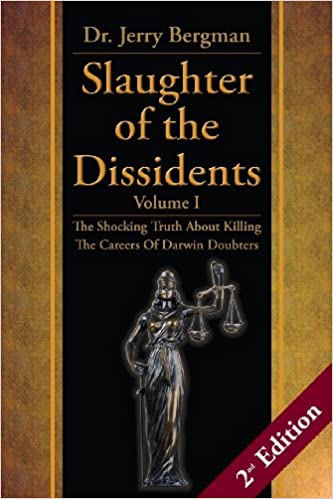
That reason is revealed in horrifying detail in Dr. Jerry Bergman’s eye-opening book, Slaughter of the Dissidents: The Shocking Truth about Killing the Careers of Darwin Doubters. In it, Dr. Bergman describes the discrimination experienced by more than a dozen Darwin-doubting scientists, primarily in academia. And we’re not talking insults at the water cooler. These men and women have been denied tenure and awards, forced out, fired, blackballed, even subjected to death threats – not because of what they did or said, but because of what they believe.

Dr. Bergman experienced this sort of Orwellian discrimination himself in the late 1970s; he had become disillusioned with Darwinism, and lost his job at Bowling Green State University for saying so. Professor Dawkins would no doubt try to slap the “not a real scientist” label on him. But it wouldn’t stick, because Dr. Bergman:

• Has nine college degrees – two of them Ph.D.s – from the Medical College of Ohio, Wayne State University, The University of Toledo, and Bowling Green State University.
• Has taught college-level biology, genetics, chemistry, biochemistry, anthropology, geology, and microbiology for more than three decades.
• Has more than 1000 publications appearing in 12 languages, including over 50 books and monographs, and has contributed to dozens of textbooks.
• Has presented scores of scientific papers in the U.S., Canada, and Europe.

In fact, the “not a real scientist” label doesn’t fit any of the Darwin doubters whose cases are presented in Slaughter of the Dissidents.

Some of these scientists have already gained recognition through the amazing documentary Expelled: No Intelligence Allowed. Dr. Bergman picks up where Ben Stein left off, delving more deeply into the cases of Caroline Crocker and Guillermo Gonzalez. He also introduces his readers to many other highly qualified scientists who saw their careers derailed when their doubts about Darwinism came to the attention of their superiors.

So aside from their personal sacrifices, what’s the harm?

Dr. Bergman points out that so far, the majority of Americans side with the Darwin doubters. Surveys indicate that at least 44% believe God created the earth and all the basic kinds of life, another 38% fall somewhere along the continuum between creationism and theistic evolution, and only 9% are pure evolutionists.

But as the product of public education myself – including a journalism curriculum teaching, as far back as the ‘70s, that what we can’t see is a figment of our imaginations – I worry about my own exhaustively educated generation, and those of the future. Now that atheistic Darwinism is the only subject that can be safely taught in our schools and universities … now that even a whiff of sympathy for Intelligent Design is punishable by immediate dismissal … and now that the God of the Bible has been booted clear out of public life … what will become of our biblically ignorant citizenry not only in this life, but far more importantly, in the life to come?

Dr. Bergman provides suggestions for supporting the fight to restore academic freedom in this country, but it seems like an uphill battle. The politically correct evolutionary worldview is championed by groups like the ACLU and Americans United for Separation of Church and State; such groups are always standing by, ready to snuff out any suggestion of a Designer with lawsuits that few schools can afford to fight.

Darwinism has long been part of the mainstream news media’s dogma, too, as consumers of mainstream media can attest – and as Dr. Bergman demonstrates again and again.

Take, for instance, the case of Rod LeVake, a Minnesota biology teacher who was removed from his high school biology class because he dared to criticize Darwinism. Incredibly, at least one national news magazine felt compelled to weigh in on his case. “Time portrayed creation-believing scientists as an almost non-existent minority,” Dr. Bergman reports, “claiming ‘reputable scientists who agree with LeVake can be counted on one hand’ … Time went so far as to portray Mr. LeVake (in a full-page article) as a hillbilly.”

No wonder we creationists and Intelligent Design advocates are so often mocked by the highly educated, who greet any suggestion of an alternative to Darwinism with some version of: “Real scientists believe in evolution!”

Now, thanks to Dr. Bergman’s efforts, we can at last explain why that may seem to be the case: Darwinism appears to be the prevailing worldview because it is the only one that is allowed in our classrooms, on our campuses, on the pages of our mainstream newspapers and the lips of mainstream broadcast reporters.

I finished Slaughter of the Dissidents more convinced than ever that it’s time for those of us who care about academic freedom – and about proclaiming the truth of the Bible – to fight this unconscionable censorship. Read this outstanding book, and you’ll no doubt agree.
0 Comments
<<Previous
Forward>>

    Kitty
    Foth-Regner

    I'm a follower of Jesus Christ, a freelance copywriter, a nursing-home volunteer, and the author of books both in-process and published -- including Heaven Without Her. 

    Archives

    August 2025
    May 2025
    November 2024
    August 2024
    May 2024
    April 2024
    December 2023
    September 2023
    June 2023
    May 2023
    January 2023
    December 2022
    September 2022
    July 2022
    June 2022
    May 2022
    April 2022
    March 2022
    February 2022
    January 2022
    December 2021
    November 2021
    October 2021
    September 2021
    August 2021
    July 2021
    June 2021
    May 2021
    April 2021
    March 2021
    February 2021
    January 2021
    December 2020
    November 2020
    October 2020
    September 2020
    August 2020
    July 2020
    June 2020
    May 2020
    April 2020
    March 2020
    February 2020
    January 2020
    December 2019
    November 2019
    October 2019
    September 2019
    August 2019
    July 2019
    June 2019
    May 2019
    April 2019
    March 2019
    February 2019
    January 2019
    December 2018
    November 2018
    October 2018
    September 2018
    August 2018
    July 2018
    June 2018
    May 2018
    April 2018
    March 2018
    February 2018
    January 2018
    December 2017
    November 2017
    October 2017
    September 2017
    August 2017
    July 2017
    June 2017
    May 2017
    April 2017
    March 2017
    February 2017
    January 2017
    December 2016
    November 2016
    October 2016
    September 2016
    August 2016
    July 2016
    June 2016
    May 2016
    April 2016
    March 2016
    February 2016
    January 2016
    December 2015
    November 2015
    October 2015
    September 2015
    August 2015
    July 2015
    June 2015
    May 2015
    April 2015
    March 2015
    February 2015
    January 2015
    December 2014
    November 2014
    October 2014
    September 2014
    August 2014
    July 2014
    June 2014
    May 2014
    April 2014
    March 2014
    February 2014
    January 2014
    December 2013
    November 2013
    October 2013
    September 2013
    August 2013

    Care to subscribe?

    Enter your email address:

    Delivered by FeedBurner

    RSS Feed

Proudly powered by Weebly
Photos from tracie7779, Luci Correia, Maxwell Hamilton, giardinaggio, Doug1021, Angel Xavier Viera, Damian Gadal, Reboots, leoncillo sabino, mRio, HikingArtist.com, guymoll, csath07, Guudmorning!, fred_v, homegets.com, ishaip, jinxmcc, freeparking :-|, CallMeWhatEver, BryonLippincott, simpleinsomnia, csread, nicephore, Doug Beckers, mandydale, berniedup, tontantravel, h.koppdelaney, Jill Clardy, anieto2k, NASA Goddard Photo and Video, QuidoX, Ryo | [ addme. ], ShebleyCL, TinyTall, proggy-yahoo, Infiniteyes, Genista, kippster, Speculum Mundi, HerPhotographer, Tauralbus, megallypuff, harshxpatel, Waiting For The Word, CoreBurn, Gordon Chirgwin, {Guerrilla Futures | Jason Tester}, John McLinden, Patrick Feller, jikatu, Peter O'Connor aka anemoneprojectors, byzantiumbooks, bizmac, H o l l y., Peter Blanchard, sheriffmitchell, Tony Webster, hectorir, City of Overland Park, luis_cunha, Sam Howzit, bertknot, QuotesEverlasting, iturde, ejmc, VARNISHdesign, Cimm, Good Book Reader, Renaud Camus, banjipark, romana klee, 00alexx, erix!, branestawm2002, amsfrank, m01229, cbcmemberphotos2477, rhode.nel, Veronique Debord, joshjanssen, zenjazzygeek, h.koppdelaney, Laurel Mill Players, quinn.anya, *ErinBrierley*, Ben Pugh, Photographing Travis, BarnImages.com, anees.waqas, swambo, Alan Miles NYC, glenngould, Patrick Feller, davecito, wade in da water, Endre Majoros, France1978, dainamara, theseanster93, insightpest, eliduke, volker-kannacher, wuestenigel (CC BY 2.0), cogdogblog, Editor B, poshdee, brewbooks, J D Mack, ThomasKohler, mayeesherr. (in West Bengal!), TEDxHouston, Ms. Phoenix, PBoGS, Eselsmann™, Inside Guide To London, ShironekoEuro, Tom Anderson, flequi, cogdogblog, njaminjami, Search Engine People Blog, ShanMcG213, Julie Edgley, randihausken, pescatello, Waiting For The Word, moriza, Iain Farrell, Arizona Parrot, digitalmindphotography, enjosmith, www.WeisserPhotography.com, STC4blues, Holidayextras, Randy Roe, goprogresswent, BenDibble, kstoyer, Rennett Stowe, williac, ImNotQuiteJack, Life Mental Health, Jose Antonio Cotallo Lopez, gruntzooki, electricinca, adactio, miheco, Zemlinki!, bnilsen, chispita_666, Francis Storr, mattbuck4950, BiblioArchives / LibraryArchives, subarcticmike, Shutterbug Fotos, faeryhedgehog, kev.neagle, mikecogh, Tjook, LladyYas, Arend Vermazeren, the hopeful pessimist, Jim Makos, John Beans, Steve @ the alligator farm, New York National Guard, cosmo_71, edenpictures, Paul Stevenson, David Paul Ohmer, Berries.com, bmstores, susan solinski, uvw916a, Free Public Domain Illustrations by rawpixel, Sthetic, Beau B, r2hox, chrisd90, bee wolf ray, Julio Roman Fariñas, BLMIdaho, shoebox27, Kris Mouser-Brown, WVTROUT, www.davidbaxendale.com, hillels, timsamoff, Graham Ó Síodhacháin, Wiertz Sébastien, Pictures by Ann, SodanieChea, berniedup, trendingtopics, Sangre-La.com, Apuane, Valeri Pizhanski, PinkMoose, MDGovpics, Tuxified, spline_splinson, BioDivLibrary, Gerry Dincher, -Ebelien-, dno1967b, joshuamckenty, homethods, GlasgowAmateur, homethods, byzantiumbooks, ell brown, d.koranda, byzantiumbooks, Tim @ Photovisions Nebraska, Vilmos.Vincze, quinn.anya, hillels, www.ilkkajukarainen.fi, akigabo, trendingtopics, 23am.com, CJS*64, Leyram Odacrem, fauxto_digit, mrdorkesq, Rushen!, jdxyw, beltz6, PersonalCreations.com, {Futuretester | Jason Tester}, Gabriel N Moreno, Steven Pisano, wuestenigel, themcny, Vassilis Online, Aramisse, logatfer, bambe1964, Glyn Lowe Photoworks., Ted Drake, Smabs Sputzer, colonelchi, ulisse albiati, TYLERHEBERT, joncutrer, edenpictures, Brett Jordan, ViaggioRoutard, R_Pigott, thedailyenglishshow, caligula1995, Film Star Vintage, Hotel Kaesong, pburka, Claudio Marinangeli, thedailyenglishshow, mikecogh, nan palmero, quinn.anya, senza senso, O.Ortelpa, efradera, Wheeler Cowperthwaite, chez_sugi, "Stròlic Furlàn" - Davide Gabino, Carodean Road Designs, Castles, Capes & Clones, alljengi, DonkeyHotey, jinxmcc, grisha_21, homethods, wuestenigel, Guido Sorarù, James St. John, donnierayjones, changeable focus, psyberartist, Pest15